

They Divide Particles for a living
What happens when an institution's founding mythology stops fitting the budget environment it has to survive in.

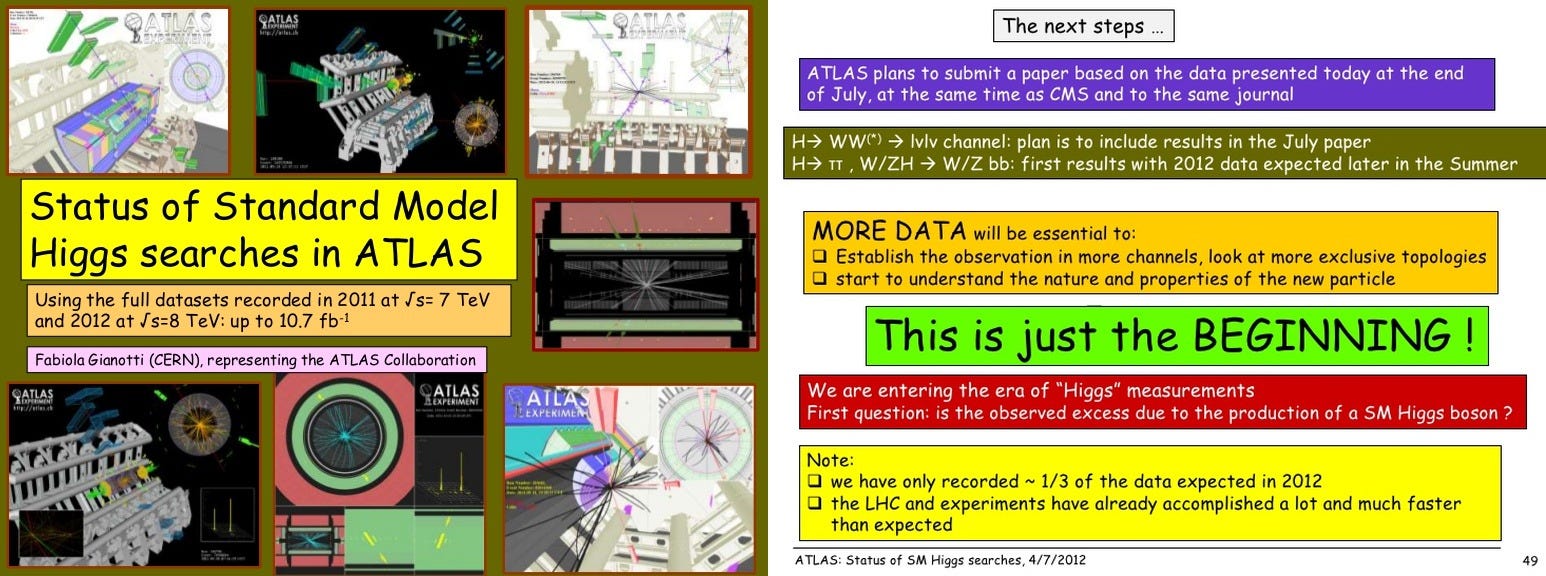
In July 2012 CERN announced the discovery of the Higgs boson, arguably the most important physics result of the century, in slides set in Comic Sans. The internet noticed the typeface before it noticed the science. A petition went around. Someone coined “Comic Cerns.”1 The lab took the mockery in good humour, which is the tell. This is an institution slightly embarrassed by its own brand, as though caring how the work looks were beneath the work itself.
Thirteen years on, the embarrassment has a cost. CERN runs a gift shop with mugs and lanyards,2 but it does not license its brand at scale the way ESA now does, with apparel lines and video-game tie-ins run through commercial partners.3 In December 2025 a group of private billionaires (Milner, Schmidt, Elkann, Niel) pledged close to a billion dollars toward CERN’s next machine, the first private pledge of its kind in the lab’s history,4 and CERN handled it like a press release rather than the opening of a story. The most recognizable scientific instrument on Earth runs a communications posture built to keep sentiment positive.5 It defends well. It rarely narrates.
I don’t believe this is a competence problem. It follows from what CERN actually is, which is something other than a science brand.
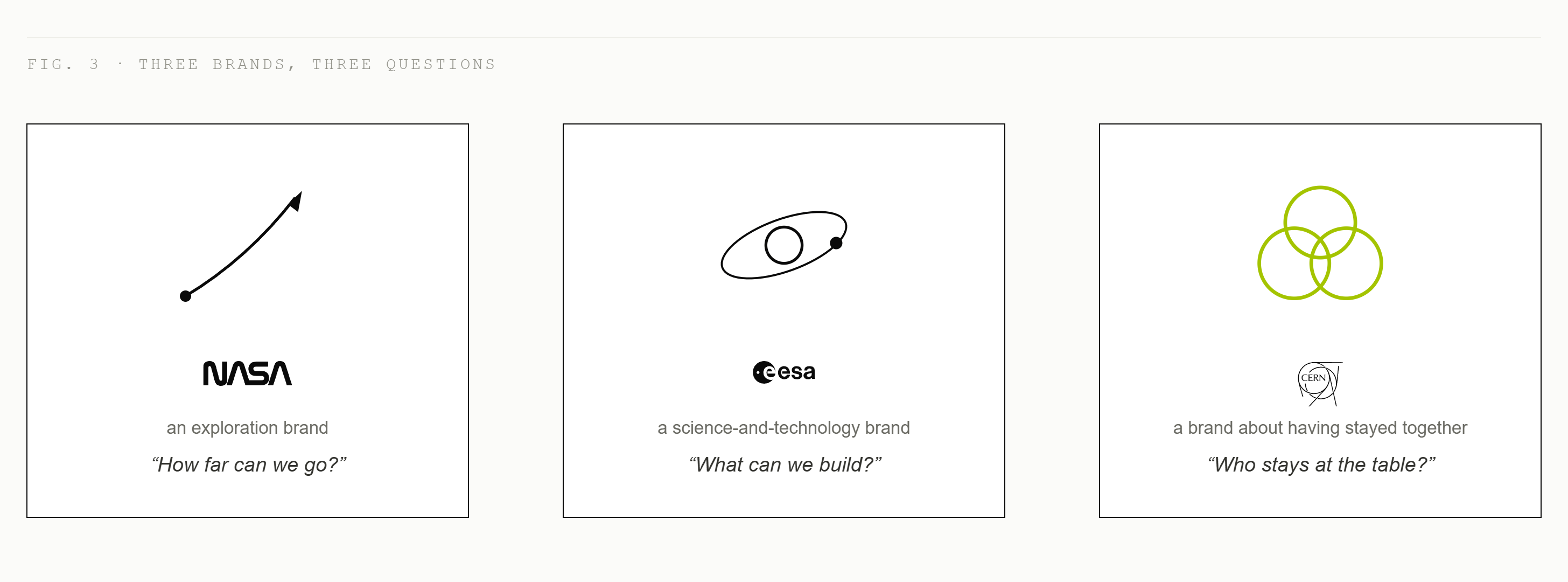
NASA is an exploration brand. ESA is a science-and-technology brand. CERN is a brand about having stayed together. Let me explain. The 1954 convention that created it was post-war reconstruction by other means: get European scientists back into one room, across borders that had just finished trying to annihilate each other.6 “Science for peace” is the unofficial motto, and it is not decoration. The product *is* the cooperation. The physics is what the cooperation happens to do.
That reading sounds soft until you notice it explains the hard facts. It explains why the December 2023 decision to end cooperation with Russian institutions7 cut deeper inside the community than a policy dispute should: the universal connector chose, for the first time, to disconnect. And it explains the strangest asset in the portfolio. The Web.
Tim Berners-Lee invented the World Wide Web inside CERN, in 1989, because the lab could not function without it. Thousands of physicists in dozens of countries had to share documents and data without anyone caring whose machine or whose passport sat on the far end. The Web was CERN’s internal operating principle made portable. Then, on 30 April 1993, CERN released it into the public domain. No patent, no licence, no royalty.8 It gave away the most valuable software protocol of the century because enclosing it would have contradicted the whole point of the place. (I should be honest that I am reading a motive into an act the record leaves unexplained. I do not know why they released it; my belief is that they did it to stay true to their own value of sharing, and I am happy to take that on faith.)
That is the self-portrait. CERN built the connector by being the connector. The Web was less an invention than a reflex. In 1993 you could say, without straining, that the Web was not something CERN made; it was something CERN was. Whether that still holds is the question sitting under the rest of this piece. The Web is the proof here, not the argument, so it is worth holding lightly before it swallows the essay.
It has become fashionable in European science-policy circles to hold up ESA as the model CERN should copy. In November 2025 ESA walked into a ministerial in Bremen and walked out with €22 billion over three years, 99 percent of what it asked for, a third more than three years earlier.9 It did this by tying space to European sovereignty, by using the Trump administration’s NASA cuts as a live contrast, and by selling a fifteen-year horizon instead of a project budget.10 Disciplined, dualistic, and it worked. Sovereignty is that kind of frame: the moment you claim it, you have named a world of others to hold it against.
ESA sells nouns. CERN sells verbs that have no nouns yet.
CERN cannot run that play, and the reason is more interesting than execution. Space is already a story. Seventy years of Apollo and Kubrick and Hubble and Mars-as-a-place have built the imaginative scaffolding, so when a minister hears “European sovereignty in space” the film is already running behind their eyes. The deeper fault line is tangibility, and it runs the length of the field. The closer a science sits to the applied and the touchable, the more its story tells itself. SpaceX livestreams a rocket landing on a barge and the narrative writes itself in real time. NASA and ESA work with objects you can point at: satellites, rovers, launchers, a place on the Moon. CERN works a layer of reality below the one our senses evolved to register, where the product is a relationship between fields rather than a thing in space.
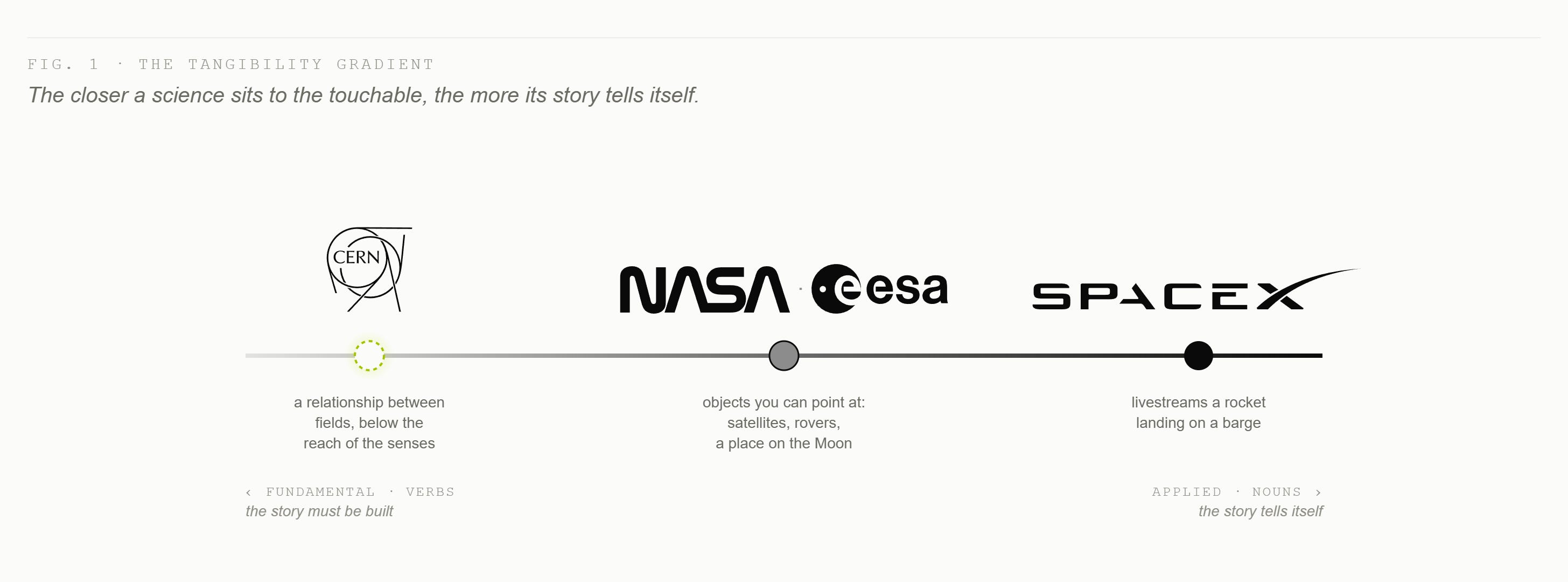
So CERN’s narrative weakness is not a failure of effort or taste. It is structural. Applied science arrives in the world as objects you can film and products you can price. Fundamental science spends its first decades as calculation, and its results may take a generation to condense into anything a camera could love. The product is invisible by design, and no amount of better communication turns an abstraction into a rocket. ESA is the neighbour with the easier product, and a little of the envy is earned.
Here is the bind. CERN cannot pitch sovereignty, because choosing a side is the one move a cooperation brand cannot make without dissolving itself. And it cannot pitch product utility, because the product sits below perception. For decades the institution resolved this by staying quiet and letting the work speak. In 2026 the silence has stopped reading as principle.
Two things changed. First, the Russia decision already took a side. Seventeen council members voted in a secret ballot to end the cooperation, France joined them, six states abstained.11 CERN is no longer neutral in fact, only in narrative, and the gap between what it did and what it says is precisely where its own community lost trust. Second, refusing to frame has become a frame. When ESA stood up and said “sovereignty,” CERN’s silence did not land on a German or Polish minister as restraint. It landed as a missing argument. In a room competing for constrained budgets, declining to state your stakes is not neutrality. It is forfeiting your turn to speak.
There is ground between “Europe against everyone” and silence, and it happens to be CERN’s home turf: knowledge as shared inheritance, the lab as one of the few benches on Earth where Iranian, Israeli, American and, until recently, Russian physicists worked side by side. Claiming that out loud is not taking a side, and it is not silence either. It is the one move ESA cannot copy, because ESA has no founding mythology to stand on. CERN has the mythology and keeps it switched off.
By 2028 CERN will ask twenty-five democratic governments to commit something north of €15 billion over twelve years for a new collider, the Future Circular Collider,12 while public trust in science falls13 and the discovery itself stays genuinely uncertain. Framed as physics, it is a hard sell to anyone who is not already a physicist. Framed as what CERN actually is, the request changes: the connective infrastructure of fundamental knowledge gets renewed roughly once every fifty years, the LHC is the current version, and the FCC is the next one. Same institution, same logic, the same gift handed forward. A gift is a noun. You do not need the Standard Model to hold one.
CERN gave the world the Web because it had to, and gave it away because that was what the place was for. The past tense is deliberate. I have finished writing this and I still cannot tell you what CERN is; I can only tell you what it was. It is not a bystander’s question to settle, and a bystander is all I am. The open question is no longer whether CERN can afford the next machine. It is whether the institution that built the connective tissue of the modern world can still make itself heard, on platforms running over the protocols it released for free. The money is mostly there. The membership is growing. What CERN has not yet decided is whether it is willing to be loved for what it is, instead of quietly admired for what it makes.
So let me end the way a designer ends, with the question that reopens the board: what would have to be true for CERN to hand the world another 1993, somewhere around 2030? Not much physics, as it turns out. CERN would have to say in public what it has always been in private: a cooperation that happens to do physics. It would have to close the distance between what it does and what it says, beginning with the honest sentence about Russia it has owed its own community since 2023. And it would have to decide that being understood is part of the work, not beneath it. I think it can. The world is dividing again along every seam it has. What it needs is not the institution of 1954 back; it needs the spirit of 1954, and a container strong enough to carry that spirit further. An institution is a demanding vessel for a spirit: spirits live by renewal, and institutions are built to resist exactly that. Carrying this one forward will ask of CERN a deeper evolution than any machine it has ever proposed. But the next gift, whatever it turns out to be, will come from somewhere people are still forced to share. There are fewer of those places every year. CERN is one of them, still.
The slides, by ATLAS spokesperson Fabiola Gianotti, are preserved on CERN’s document server (Indico, event 197461, 4 July 2012).
The CERN Shop operates inside Science Gateway in Geneva. There is no online store, which rather makes the point.
ESA runs an active licensing programme through commercial partners, covering apparel, toys, games and film tie-ins: ”Unlock the power of space with the ESA brand,”
€860 million (about US$1 billion), pledged in December 2025 by a group led by Yuri Milner, Eric Schmidt, John Elkann and Xavier Niel toward the Future Circular Collider. See ”Future Circular Collider,” Wikipedia, and CERN’s press materials.
CERN’s stated social-media goal centres on keeping sentiment positive and handling negative sentiment constructively: CERN International Relations, social media strategy.
The CERN Convention was signed in 1953 and the organization established in 1954: ”Our history”
Decided December 2023, effective late 2024, ending agreements covering roughly 500 Russian-affiliated researchers: Chemistry World.
Tim Berners-Lee’s 1989 proposal and the 30 April 1993 public-domain release are documented at ”The birth of the Web”.
ESA’s November 2025 ministerial in Bremen closed at €22.067 billion over three years, 99 percent of the request and a 32 percent increase over 2022: SpaceNews.
Reported by The Geneva Observer, which called the consequences for science diplomacy epochal.
The FCC Feasibility Study (March 2025) puts the electron-positron stage at roughly CHF 15 billion over about twelve years, with the construction decision expected around 2028: ”CERN releases report on the feasibility of a possible Future Circular Collider,” home.cern.
By mid-2025 only 8 percent of US adults reported a great deal of trust in science, down roughly 24 points from pre-pandemic levels, with 34 percent reporting little or none: Social and Personality Psychology Compass (Wiley, 2025).